 Skip to content
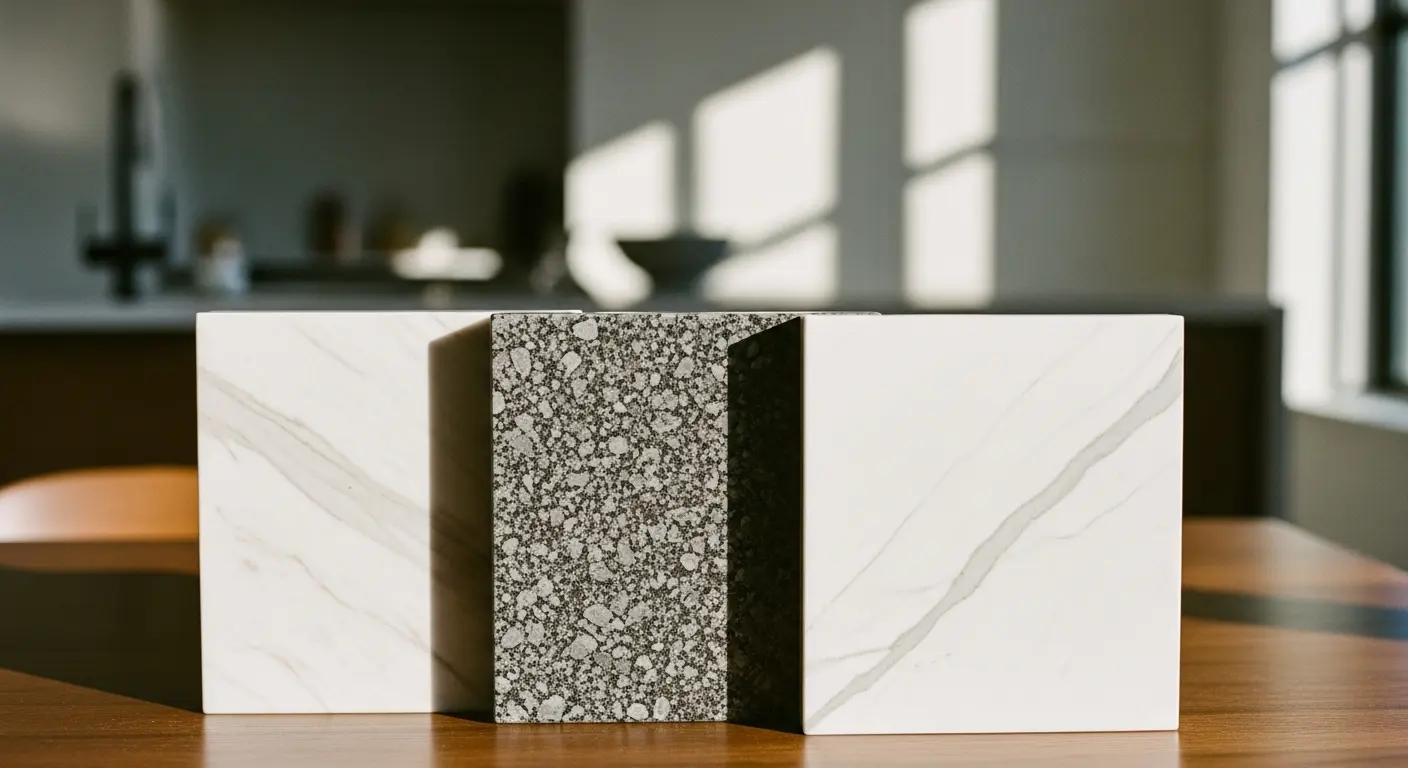
Choosing a new countertop is a significant investment. With so many options available, homeowners often find themselves caught in the classic debate: Quartz, Granite, or Porcelain?
While all three are premium materials, they perform differently depending on your lifestyle, cooking habits, and whether your project is indoors or outdoors. In this guide, we’ll break down the pros and cons of each to help you make the right choice for your home.
The Big Three: At a Glance
Before we dive into the details, here is a quick comparison of how these materials stack up in the areas that matter most.
Countertop Comparison Guide
| Feature | Quartz | Granite | Porcelain |
| Composition | Engineered (Stone + Resin) | 100% Natural Stone | Engineered (Vitrified Clay) |
| Sealing Required? | Never | Yes (Every 1–2 years) | Never |
| Heat Resistance | Moderate (Use trivets) | High | Excellent (Torch-proof) |
| Stain Resistance | Excellent | Good (If sealed) | Excellent |
| Outdoor Use | No (Fades in UV) | Yes | Yes (Best for weather) |
1. Quartz: The Low-Maintenance King
Quartz is currently the most popular choice for indoor kitchens. Because it is non-porous, it is virtually impossible to stain.
- Pros: Incredible color consistency; no sealing required; wide variety of patterns.
- Cons: Not heat-proof (the resin can melt); not suitable for outdoor use.
- Best For: Busy families with kids, modern indoor kitchens, and those who want a “set it and forget it” surface.
2. Granite: The Natural Powerhouse
For those who love the idea of “one-of-a-kind” beauty, granite is the gold standard. Every slab is a unique piece of Earth’s history.
- Pros: Highly heat resistant; adds significant resale value; completely natural.
- Cons: Requires periodic sealing to prevent stains; patterns can be unpredictable.
- Best For: Traditional or rustic designs, active cooks who put hot pans on the counter, and natural stone purists.
3. Porcelain: The Modern Versatile Solution
The rising star of the industry. Porcelain offers the durability of stone with the sleekness of modern engineering.
- Pros: UV resistant; impervious to heat and scratches; can be used for thin-profile designs.
- Cons: Installation requires specialized fabricators due to its hardness and thinness.
- Best For: Outdoor kitchens, ultra-modern minimalist designs, and wall cladding.
Expert Recommendation: Match Your Lifestyle
Choosing the best countertop material for kitchens depends on how you use your space:
- The “Home Chef” (Heavy Cooking): Go with Granite. You won’t have to worry about burning the surface with a hot pot.
- The “Hectic Household” (Low Maintenance): Go with Quartz. Spilled wine or juice won’t stand a chance.
- The “Outdoor Entertainer”: Go with Porcelain. It is the only material that will look brand new after years of sun and rain exposure.
Decision Checklist: Which One Should You Buy?
Use this checklist to narrow down your top choice:
- Are you installing outdoors? (If yes, choose Porcelain or Granite).
- Do you hate the idea of yearly maintenance/sealing? (If yes, choose Quartz or Porcelain).
- Do you want a “Waterfall” edge or a very thin, sleek look? (If yes, choose Porcelain).
- Is heat resistance your #1 priority? (If yes, choose Granite or Porcelain).
- Do you want a specific, uniform color for a large area? (If yes, choose Quartz).
Conclusion
There is no single “best” material, only the best material for you. Whether you value the natural uniqueness of granite, the ease of quartz, or the extreme durability of porcelain, Remarkable Stone Design is here to help you fabricate and install your dream surface.
